magic
practical techniques
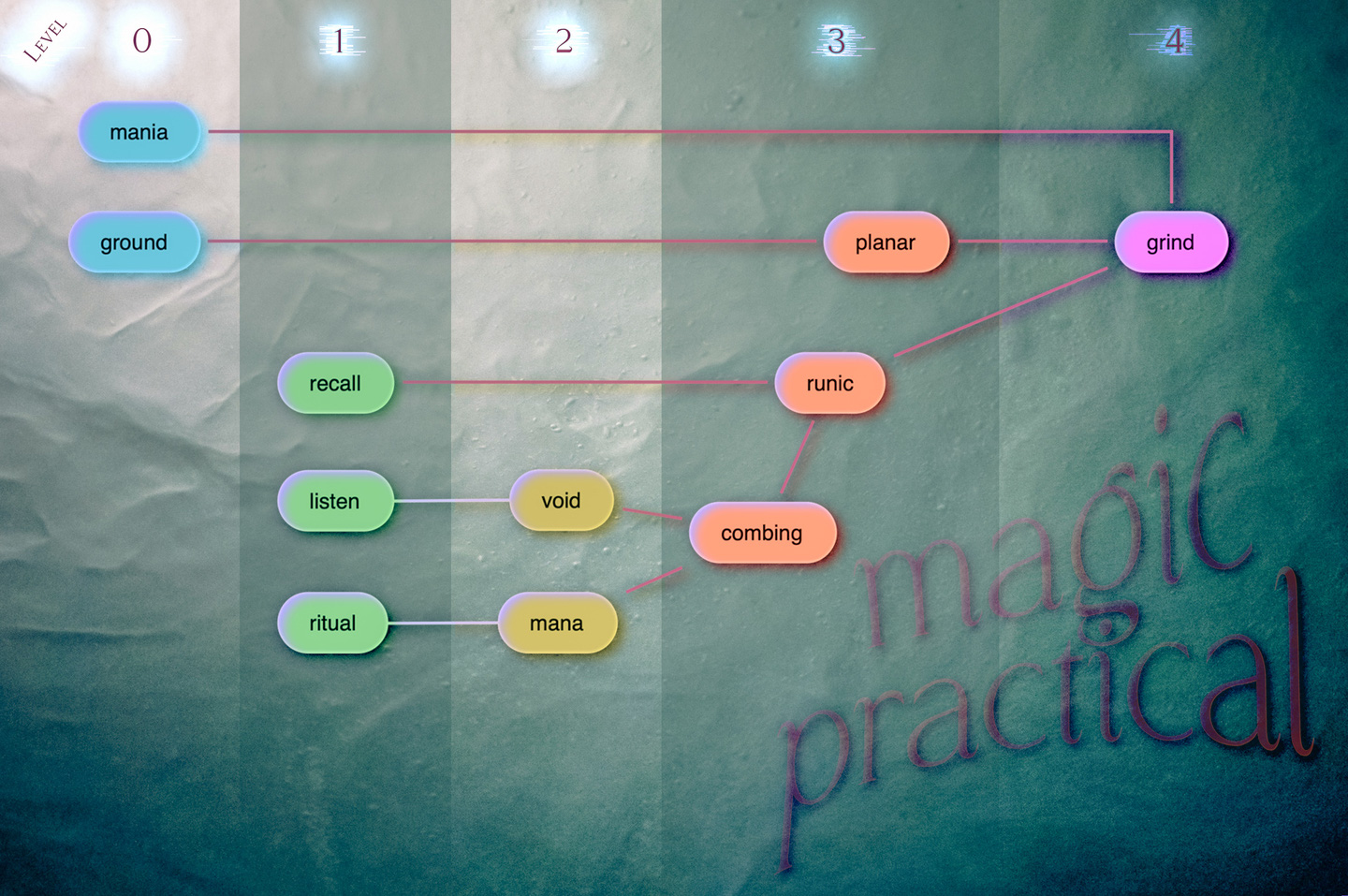
level 0
we all start here
center / ground
count off and name:
- 5 things we can see
- 4 things we can hear
- 3 things we can smell
- 2 things we can feel
- 1 thing we can taste
the essence of living is interacting with the world through our senses. yet our inner world can come to dominate our awareness of the outer. grounding is important, to give us a breath, and a moment of perspective
mania / mad
mania is the pattern-breaking energy
all other magic weaves patterns; mania is a power with the sole purpose of breaking pattern
mania feels like a resource we collect and burn, much as “spoons”
may substitute collaboration, when available
level 1
these require study
state / recall
the world is built from stories
being able to tell a good story gives us power to shape other people’s perspectives
the point of our ego in our brain is to explain why i -specifically make sense. our ego will fucking lie to make its point, but so long as we know that, it’s a power we can harness like any other
observation / listen
being heard is incredibly validating to our sense of self
true listening is trying to understand:
- what the person is saying
- why they are saying it
- why they believe that’s important
… and buying into it, momentarily, for as long as we want the conversation to persist
this is like improv: we can not deny the other person’s reality, we must validate it
note: a lot of men especially will fall in love with someone who listens to them
in biz school, they taught us to count to twelve in our head, after we ask someone something, before assuming they’re not going to answer and moving on. good advice; seems to work
pattern / ritual
that which we repeat gains importance to us
the more precisely we understand process and repeat steps, the more predictable our results
level 2
these flow from level 1
silence / void
space left deliberately unfilled
evolves from listen
void is more than leaving space to listen, it’s a recognition of what should not be discussed, or perhaps what should not be discussed in the current context
accumulation / mana
evolves from ritual
total sum of invested effort
actual progress on any front is achieved not from planning but actual labor. we use plans and tools as force multipliers, but even without either it’s usually possible to still make some gains. what matters is how much energy we’re able to accumulate in any single direction, cumulatively, over all time
frequent, regular contributions matter more than sporadic big ones
how do we empty an ocean? one teaspoon at a time
level 3
we begin to combine priors
coliniation / combing
evolves from mana and void
like petting a cat
the way to brush long hair is gently, with slow strokes, willing to turn out and start a new stroke whenever we hit a knot. we de-snarl not from pushing through the tangle, but by teasing it out
the way to pet a cat is similar
the way to add quality to any type of project is to run over its lines, curves, or exposed surfaces, over and over, de-snarling small tangles as we find them. we do not know what we are setting out to fix, we just know we will find things that need fixed and fix them as we go
working quality into the cracks
spell / runic
writing something down adds to the cohesiveness we can build
this is like combing our recall. when our own story is presented linearly, it’s easier for us to find and work on flaws
forcing a spell is bad though. if we can’t form a cohesive story when writing down our meaning, it usually indicates we don’t yet have understanding
orthogonal / planar
evolves from ground
(forgive me please one abstract concept on a page of practicals)
we have a tendency to evaluate information on axis. for instance: that which is true against that which is false
but then there’s also that which is meaningless and neither true nor false. this is a completely separate axis totally outside of true/false, and shares no characteristics with true/false
in math we call this an orthogonal axis
in electrical engineering we call that which is neither true nor false high-Z. in eastern philosophy it’s called mu, and the most famous example is: does dog have buddha nature?
in spreadsheets, we make a pivot table where we swap rows and columns to aggregate data in new ways
in aikido there’s a concept called musubi where a cause and an effect are wrapped so tightly around each other it becomes impossible to tell which is which
the point is, we like to classify information. orthogonal or not, every new axis we can classify against lets us access another perspective. if we go searching for new axis, new perspectives, we may find one that gives us position and strength
a skilled aikidoist can gently tilt an attacker’s energy such that their attacker violently slams themself into a wall
a skilled mage can do the same using perspectives
level 4
putting it all together
slow / grind
when runic coliniation is applied maniacally to process itself, with a mind for planar reinterpretation of every step, what results is basically creative refinement
said another way:
- we meticulously write down our plans or methods
- we punch deliberate holes in them
- with planar reinterpretation, forcing ourself to re-interpret them in new ways
- and mania enthusiasm, letting ourself break every fundamental rule that annoys us
- then keep improving the plans until they’re intact once more
usually this involves simplifying and becoming more complex, at the same time. that is, simplifying our visible complexity while increasing the invisible density of reasons why we do things the way we do
this is guaranteed to slow us down on any front we’re making progress
for example, when modeling real-world plans into computer code, i tend to simplify both down to flat surfaces: a narrative document on one side, a python file on the other. often this requires trimming out parts that don’t fit well. then i start translating concepts from each side to the other. eventually, problems in both sides become apparent
what is important here is to not regard either one as right. the code we write is as flawed as our plans. what we’re doing is using the planar divide itself to reveal holes in both
accordingly, it is likely this magic requires left-right brain cooperation to succeed
level 5
to make it plain, what i describe as planar magic is metaphor
there exists a profession of studying metaphor. metaphor is at heart reinterpreting ideas across different mediums. the people who do this for a living we name as various types of “artist”